
How to include Design Thinking and carry out Service Design Sprint?
As part of WP3, the three European partners provided content on the theory behind Design Thinking in ToT2 and allowed HEI partners from Moldova and Georgia to experience a Service Design Sprint themselves in ToT3 in Comrat, Moldova.
Integrating a real-life challenge and business partner into the Sprint creates a win-win situation for all stakeholders involved. A service design sprint helps HEI make teaching more applied, engaging, and connected to external partners in the real word. The business partner gains fresh ideas, user-focused insights, and early prototypes without committing to full development. Students gain practical experience with real challenges, helping them build teamwork, problem-solving, and prototyping skills. Overall, all three benefit from a short, structured co-creation process that turns a real challenge into actionable innovation.
Following the double diamond, the sprint can be divided into 4 phases:
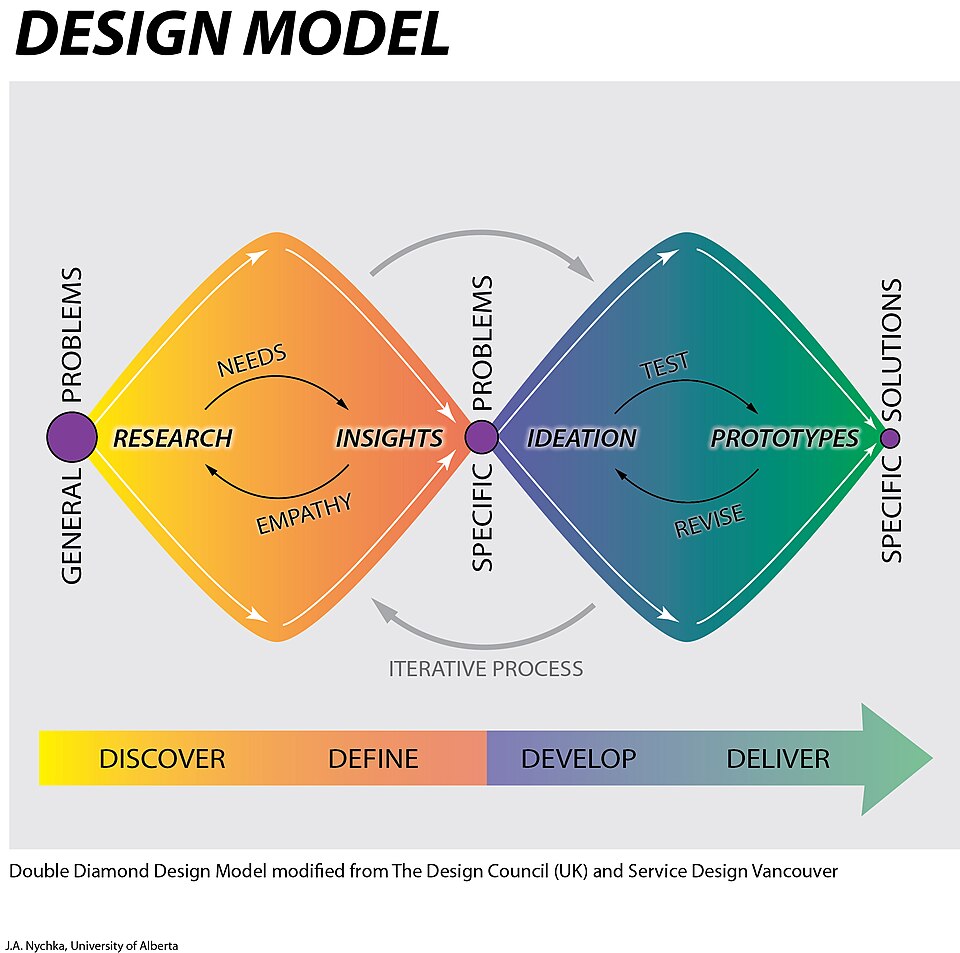
- Discover: In this first phase, students get an introduced to the challenge and need to do research in order to get more insights into the problem. This can be done through various research methods, such as contextual interviews, observation, auto- or mobile ethnography and others.
- Define: All the collected material then needs to be structured, e.g. through a research wall, where common patterns are identified. The development of key insights or how might we questions help define the problem. It is crucial to make sure that students have understood the problem, in order to solve the right problem.
- Develop: Once the problem is defined, students can start thinking about possible solutions. This can be done through ideation, where students learn how to become more creative and produce a lot of ideas in a short time, e.g. through the Crazy 8. Ideas then need to be priortized, e.g. in an idea portfolio.This gives the students an opportunity to decide, which ideas they want to work with.
- Deliver: Also for prototyping, various methods can be applied and combined to help make the idea visible, touchable and testable. As most ideas fail, they need to be tested in an iterative way. Following the approach of “fail early, fail cheap” students learn that an idea is worth nothing. Through various feedback loops students refine their prototypes.
The book “This is Service Design Doing” By Marc Stickdorn, Adam Lawrence, Markus Hormess and Jakob Schenider provides a lot of helpful methods for such a sprint. More information in research methods can be found here: https://www.thisisservicedesigndoing.com/methods
MCI Tourism in Innsbruck, Austria, carries out one Design sprint each year with around 50 master students. Practical partners have been an outdoor mining museum, the alpine destination of Wipptal, the Alpine zoo of Innsbruck, or to a project cooperation with the Austrian Alpine Club on more accessibility on mountains.
Haaga-Helia UAS in Finland uses service design and design sprints in many courses. Read about the service design education at Haaga-Helia in this blog post: Service Design education at Haaga-Helia: a legacy of impact and innovation. The Lab8 Tool Factory has many tools and templates that can be used in service development and learning. Check out the Tool Factory, e.g.,: Trend canvas and Persona mapping. Design sprints are an innovative learning method for the 21st century skills of collaboration, critical thinking and complex problem-solving, creativity and communication. Design sprints are carried out on Haaga-Helia campuses as well as by our teachers in China, for example. Read about these experiences in the blog posts below: